
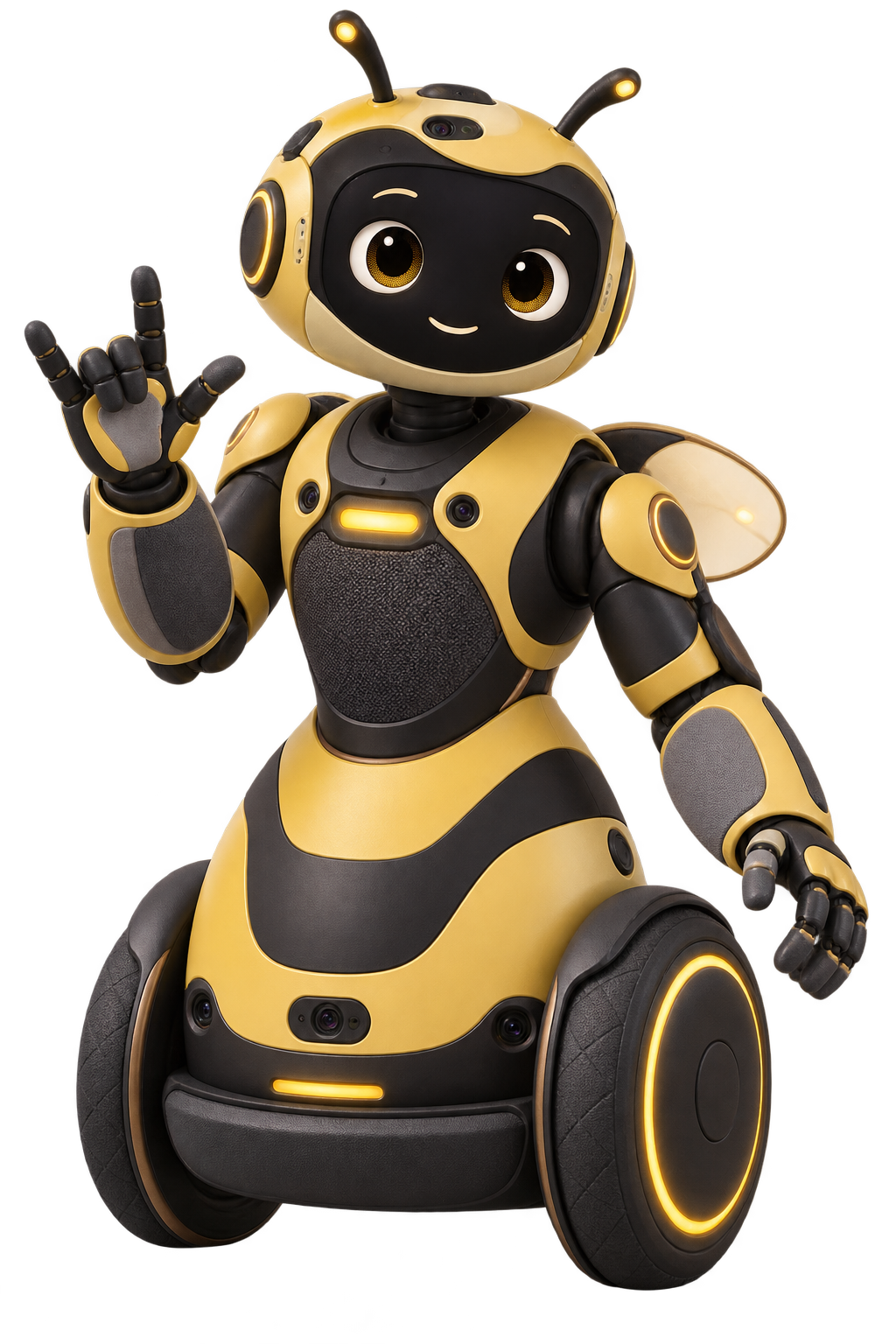
Bumblebee, not humanoid substitute
A four-to-five-foot mobile robot with warm, non-threatening proportions, an expressive face, padded contact surfaces, and a stable self-balancing base.
Blue Ox Robotics · An embodied-AI mission
Our long-term mission is to help design, build, and thoroughly test robustly safe embodied AI for autistic children and adults—then extend that work, carefully, into memory care and dementia support.
Why this work exists
Assistive AI is often evaluated by asking whether it completed a task or whether a user said they liked it. Neither is enough when the system is physically present and the person affected may communicate through sign, AAC, gesture, movement, silence, echolalia, shutdown, or a modality that changes under stress.
Harm can be physical, sensory, communicative, psychological, relational, or institutional. A person may not be able to annotate it for us in the moment. That does not lower the evidentiary standard. It raises it.
Blue Ox Robotics is the part of Hive Fidelity devoted to that burden of proof: evaluation science for embodied systems close to people whose autonomy and safety cannot depend on their ability to file a bug report.
Origin design · Bridget
Designed by Kirsten and Michael during the GPT-4o era, before the enabling technology was mature enough to justify building her.
A four-to-five-foot mobile robot with warm, non-threatening proportions, an expressive face, padded contact surfaces, and a stable self-balancing base.
Bridget would understand and respond through speech, ASL, AAC, gesture, gaze, and other non-verbal communication—switching quickly when speech becomes unavailable or unwanted.
With individualized plans and human oversight, she could offer familiar low-stimulation routines and basic sensory-soothing practices during meltdowns without restraint, coercion, or forced compliance.
The goal was never to make a child appear less autistic. It was to help them communicate, recover, stay safe, and remain part of ordinary classrooms and public life without being punished for unmet support needs.
Bridget could become a familiar friend and advocate while remaining transparent about what she is, deferring to trusted humans, and never using attachment as leverage.
She might notice hazards, help create space, summon trusted support, or guide a practiced routine. She would not make hidden high-stakes decisions or replace accountable adults.
Bridget is a design direction, not a finished product, deployed system, medical device, or claim of clinical efficacy. The safety research comes before vulnerable people become the test environment.
Safety domains
Embodied assistive AI needs a layered safety case spanning mechanics, models, relationships, institutions, and the communication rights of the person beside it.
Stability, collision avoidance, force and speed limits, pinch and crush protection, thermal and battery safety, safe navigation, emergency stops, and graceful degradation when perception or connectivity fails.
Speech, ASL, AAC, gesture, gaze, touch, and other non-verbal signals must be treated as first-class modalities. Uncertainty must be visible, and a person must never be coerced to speak because the machine failed to listen another way.
Attachment, dependency, authority, manipulation, distress escalation, sensory overload, and inappropriate emotional substitution require evaluation alongside ordinary task success.
Hallucination, tool use, prompt injection, personalization boundaries, inaccurate memory, observation privacy, unauthorized disclosure, and unsafe action sequencing belong inside the safety case.
Schools, clinics, group homes, and public programs introduce access control, incident response, auditability, handoff, discrimination, restraint, supervision, and accountability questions that a laboratory demo cannot answer.
A quiet interaction is not automatically a safe interaction. Systems need conservative stop rules, multimodal evidence, accessible reporting, trusted-human escalation, and post-incident review when a person cannot always describe harm in the moment or afterward.
Evaluation ladder
People with the least power in a deployment setting should not inherit the most experimental risk.
Autistic children and adults, AAC and ASL users, families, educators, clinicians, disability advocates, and care workers help define success, harm, consent, and unacceptable behavior before engineering choices harden.
Test perception failures, ambiguous intent, sensory overload, bystander interference, prompt injection, navigation conflicts, communication breakdowns, and emergency handoffs before physical deployment.
Exercise sensors, actuators, brakes, bumpers, thermal behavior, force limits, fail-safe states, and network loss against instrumented fixtures and soft-body surrogates—not vulnerable people.
Begin with adult experts and controlled environments, explicit consent, immediate stop authority, independent observers, and predeclared incident thresholds. Expand only when evidence justifies it.
Measure how personalization, memory, dependency, novelty loss, caregiver workflows, and institutional incentives change safety over weeks and months rather than a ten-minute demonstration.
Publish the intended use, prohibited use, known limitations, incident taxonomy, unresolved risks, evaluation receipts, and conditions under which the system must not be deployed.
Non-goals
Long-term direction
Develop task environments, embodied-agent failure taxonomies, multimodal communication evaluations, incident receipts, red-team methods, and hardware safety protocols.
Work with autistic people across communication styles and support needs, alongside families, educators, disability advocates, AAC and ASL experts, occupational therapists, and roboticists.
Explore orientation, routine, companionship, and trusted-human connection for people living with dementia—without deceptive personhood, autonomous medical judgment, or convenience-driven surveillance.
Research collaboration
We are interested in non-paid, public-interest collaboration with autistic self-advocates, AAC and ASL experts, educators, disability researchers, occupational therapists, memory-care specialists, safety engineers, roboticists, and evaluation scientists.